June 2026 | Brooke & Emma | Ramblin’ Man
There’s a sound no RVer wants to hear on the highway: a grinding
whine coming from a wheel well, followed by smoke, followed by flames.
It sounds dramatic — because it is. And the unsettling truth is that
this scenario plays out on American roads more often than most RV owners
realize, and almost every time, it could have been prevented with one
straightforward maintenance task: repacking the wheel
bearings.
We’ve built our business around keeping rigs on the road and out of
ditches. Wheel bearing repacks are one of the most requested services we
perform at rallies and campsites nationwide. We’ve seen bearings that
are so dry they’ve turned to metal dust. We’ve pulled hubs that were
scorched black from internal heat. And we’ve had conversations with
rattled owners who came within a mile of losing their entire rig to a
fire.
This article is going to lay it all out — what wheel bearings
actually do, what happens when they fail, what the data says, and why
this one maintenance item deserves a spot at the very top of your annual
checklist.
What Are Wheel
Bearings and What Do They Do?
Wheel bearings are the small but mighty components that allow your
trailer’s wheels to spin freely around the axle spindle. They sit inside
the hub and are packed in grease to reduce friction, dissipate heat, and
keep metal from grinding on metal. On a typical towable RV with two or
three axles, you’ll have two sets of bearings per hub — an inner bearing
and an outer bearing — which means anywhere from eight to twelve
individual bearing sets on your rig.
These bearings are under constant load. Every mile of highway — every
pothole, every hard stop, every long stretch in summer heat — generates
friction and heat inside that hub. The grease is the only thing standing
between a smooth trip and a roadside crisis.
The problem? That grease doesn’t last forever.
The Fire Risk Is
Real — Here’s What the Data Says
This is where most RV owners are surprised. Wheel bearing failures
don’t just cause breakdowns. They cause fires. And the
statistics from federal agencies back this up.
According to the National Fire Protection Association
(NFPA), which categorizes motorhomes and RVs under highway
vehicle fire data:
64% of vehicle fires originated in the engine, running gear,
or wheel area. (Ahrens, NFPA — “U.S. Vehicle Fire Trends
and Patterns,” 2010)
That’s nearly two out of every three vehicle fires tracing back to
the very components that wheel bearings are part of.
The NFPA’s annual averages from 2003–2007 found approximately
2,920 motorhome and camper fires and 1,330 travel
trailer fires per year in the United States. While not all of
these are bearing-related, studies and fire service surveys consistently
point to the wheel and running gear area as a primary origin zone.
The U.S. Fire Administration’s research on RV fire
hazards, citing industry analysis, notes that tire and wheel fires
account for approximately 20% of RV fires — making it
the second most common fire category after engine fires. When a bearing
fails catastrophically, the resulting heat can ignite the hub grease,
the brake components, the tire sidewall, and — if the wheel separates —
the undercarriage of the trailer itself.
A survey of fire departments across the U.S. found that 20.9%
of respondents had encountered tire or brake fires as a
mechanical cause of RV-related fire incidents, with 73% of departments
confirming they had responded to an RV fire while the unit was actively
traveling on the road.
In short: this is not a theoretical risk. These fires happen. On
highways. While families are traveling with an RV.
NHTSA
Recalls: The Industry Has Had to Own This Problem
The National
Highway Traffic Safety Administration (NHTSA) has issued multiple
recalls related directly to trailer wheel hub bearing failures. These
aren’t obscure edge cases — they involve major manufacturers and tens of
thousands of units.
Multiple travel trailer manufacturers were recalled
in the same NHTSA action after it was found that inner wheel hub
bearings had not been sufficiently greased at the factory, which
could cause the bearings to overheat and fail. According to
rv-pro.com reporting on the NHTSA action: “The
inner wheel hub bearings may not have been sufficiently greased, which
can cause the bearings to overheat and fail.” The recalls required
each manufacturer to notify owners and inspect and re-grease the
affected hubs.
A major travel trailer and fifth wheel manufacturer
faced a separate widespread recall after it was determined that some
axles were missing inner bearing races on the hubs, which could
cause the bearing to burn out or cause the hub to overheat. This recall
affected a significant number of units across multiple product
lines.
Transport Canada (the Canadian equivalent of NHTSA)
issued a separate recall involving another manufacturer’s travel
trailers, noting that the bearing issue “may result in excessive
movement of the wheel hub, which could cause the bearing to become
overheated and worn — bearing failure can cause…” — with the
consequences including fire and wheel separation.
You can search for open recalls and complaints on your own unit at NHTSA’s Safety Issues
Search or report a safety problem at NHTSA.gov/report-a-safety-problem.
The key takeaway from these recalls is sobering: even
brand-new trailers have shipped from the factory with improperly greased
or improperly assembled bearings. If manufacturers can’t
guarantee it was done right at the factory, you certainly can’t assume
it’s been maintained properly since.
How Often
Should You Repack Your Wheel Bearings?
With the fire data and the recall history in mind, the importance of
staying on top of this service becomes even clearer. The standard
industry recommendation for conventional grease-packed wheel bearings on
a towable RV is:
- Every 12,000 miles under normal towing
conditions - Every 12 months if you don’t hit the mileage
threshold — because grease degrades over time even when a rig is
parked - Immediately if you’ve towed through deep water or
floodwater (water intrusion is a bearing killer) - Immediately if you hear grinding, feel vibration,
or notice a hub that’s unusually hot to the touch after a trip
We recommend scheduling this service annually — for
most RV owners, that’s a natural rhythm that aligns with pre-season
prep. Think of it as your spring tune-up before you head out to rally
season.
But here’s the most important thing we can tell you:
whether you just bought a brand-new trailer off the lot or picked up a
used rig from a private seller, the very first maintenance item
on your list should be a bearing repack. As we covered above,
multiple major manufacturers have shipped trailers with under-greased or
improperly assembled bearings from the factory. And with a used trailer,
you have no way of knowing when — or if — the bearings were ever
serviced. Don’t assume. Get it done before your first trip.
A note on oil-bath hubs: Ramblin’ Man does not
recommend oil-bath hub systems. We have seen too many failures with them
in the field. We work exclusively with conventional grease-packed
bearings, and that is what this article covers.
Warning Signs You Can’t
Ignore
Between service intervals, your bearings will sometimes try to tell
you something is wrong. Don’t ignore these signals:
- Grinding, humming, or rumbling coming from the
wheel area while underway - Hub that’s hot to the touch after stopping — a
properly serviced hub should be warm, not painful to hold - Wobble or play in the wheel when you shake it side
to side with the trailer jacked up - Smoke or burning smell from the wheel area — this
is an emergency; pull over immediately - Grease on the outside of the hub or on the tire — a
failed seal is letting grease escape (and contaminants in) - Your axle temperature sensors reading elevated
temps while towing — if you’re running a system like the
HaloView BT7 with axle temperature sensors, this is exactly what it’s
there to catch
If you’re seeing any of these signs, especially numbers 4 or 5, you
need to stop and get that hub inspected before driving another mile.
What Happens During
a Wheel Bearing Repack?
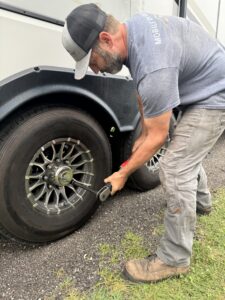
Here’s what a proper bearing repack involves — this is our actual
process:
- Jack and support the trailer safely on rated jack
stands - Remove the wheel and tire
- Pull the hub off the spindle
- Remove the old bearings and seals — this is where
we see what’s really going on inside - Clean everything — the hub, the spindle, the races
— solvent clean until it’s completely bare metal - Inspect the races and bearings for pitting,
scoring, discoloration from heat, or wear patterns that indicate a
problem - Pack the new or serviceable bearings fully with
fresh, appropriate-grade grease — we work grease through every roller by
hand - Install new inner seals — the seal is a one-use
item and should always be replaced - Reinstall the hub and bearings onto the spindle
with proper preload — not too tight, not too loose - Install and properly set the castle nut and cotter
pin - Reinstall the hub cap
- Reinstall the wheel and torque to spec — and
recheck torque after 50 miles
We also take this opportunity to inspect the brake shoes, magnets,
drums or rotors, and the overall condition of the spindle. A bearing
repack is a natural window to catch anything else that needs
attention.
A Word on Hub Caps (Dust
Caps)
Your hub cap — also called a dust cap — is not just cosmetic. It’s
the last line of defense keeping contamination out and grease in. There
are two types: hammer-on caps and threaded
caps. Knowing which type you have matters when it comes to
replacement and upgrades.
If you have threaded dust caps, we prefer the
Valcrum caps over standard plastic threaded caps.
They’re well-made and seal reliably. The one exception: if your trailer
is equipped with Deemaxx lexan caps, those hold up well
and we have no issue with them.
A note on Bearing Buddies — those spring-loaded,
grease-pressurized caps you see on a lot of trailers. Bearing Buddies
are not really necessary for RV use. They’re far more common on boat
trailers, where the hubs actually go underwater and you need that
positive pressure to prevent water intrusion. On a standard tow-behind
RV that stays on the road, a quality hub cap that seals properly is all
you need. Bearing Buddies aren’t harmful, but don’t feel like you need
to run them just because you’ve seen them on other rigs.
Should You DIY or Call a Pro?
Repacking wheel bearings is a legitimate DIY job for mechanically
inclined RV owners. The tools aren’t exotic, the parts aren’t expensive,
and there are solid instructional resources out there to walk through
the process step by step. Keep an eye out for Ramblin’ Man — you’ll find
us featured in videos from other YouTube creators covering RV
maintenance, so if you spot a familiar face, you know you’re watching a
solid walkthrough you can follow along with to perform a great bearing
repack. If you’re comfortable with the process and have access to a
quality torque wrench, a bearing packer tool, and a safe place to work,
go for it.
That said, there are real consequences for doing it
wrong:
- Over-tightening the spindle nut preloads the
bearing and generates heat from the moment you drive away - Under-tightening allows the bearing to walk on the
spindle and fail - Incomplete cleaning leaves old contaminated grease
mixed with the new — which defeats the purpose - Not replacing the seal is one of the most common
DIY mistakes we see, and it almost always leads to premature
failure
If you’re not confident in the process, or if your rig is a heavier
unit — a 5th wheel, a large toy hauler, a three-axle monster — having a
certified tech perform this service is worth every dollar. The cost of a
repack is a fraction of what you’ll pay for an emergency roadside
callout, a new axle, or a totaled trailer.
Pre-Season Bearing Checklist
Before you hitch up for the season, run through this:
- When was the last bearing repack performed? More than 12 months or
12,000 miles ago? Schedule it now. - If this is a new or new-to-you trailer, schedule a repack before
your first trip — no exceptions. - Check your hub caps — are they intact, tight, and showing no grease
weeping? - Check NHTSA’s recall database for open recalls on your make and
model. - Inspect your hubs visually for grease on the outside of the hub or
on the brake drum. - After your first trip of the season, let your hubs cool and check
the temperature — they should be warm, not hot. - Consider adding axle temperature sensors to get real-time bearing
health data while you’re underway.
The Bottom Line
Wheel bearings are one of the least glamorous maintenance items on
your rig. They’re hidden behind hub caps, out of sight and out of mind —
right up until they’re not. The fire data is clear. The recalls are
documented. The warning signs are real. And the fix is
straightforward.
At Ramblin’ Man, we do bearing repacks at rallies all season long.
We’ve met owners who had no idea their bearings hadn’t been touched in
five years. We’ve met owners who were hours away from a catastrophic
failure and didn’t know it. And we’ve met owners who did things right,
caught problems early, and kept their adventures rolling without
drama.
That last group is who we want you to be.
If you have questions about your hub setup, your service interval, or
you want to schedule a bearing repack at an upcoming rally, reach out to
us — we’re happy to help.
Safe travels. Keep those bearings packed.
— Brooke & Emma | Ramblin’ Man Mobile RV Service
Sources & Further Reading
- NFPA
— “U.S. Vehicle Fire Trends and Patterns” (Ahrens, 2010) - USFA/FEMA —
“Fire and Safety Hazards of Recreational Vehicles” (Baum, 2016) - NHTSA — Search
Safety Issues & Recalls - NHTSA —
Report a Safety Problem - rv-pro.com
— NHTSA Recall Reporting on Travel Trailer Bearing Defects
Disclaimer
This article is intended as a general educational resource for RV
owners. Wheel bearing service intervals and procedures vary by axle
manufacturer, hub type, grease type, and towing conditions. Always
consult your axle manufacturer’s documentation and a qualified
technician for service specific to your unit. If in doubt, have a
certified RV technician inspect your hub assembly before operating your
vehicle.